












Deep inside your cells is a sophisticated control system that helps determine whether your body focuses on growth and energy storage or shifts into protection, repair, and cleanup mode. This system centers around a family of proteins known as FOXO, short for Forkhead Box O.
FOXO proteins are not a trend in longevity science. They are among the most well validated longevity regulators discovered in humans. Certain genetic variants of FOXO3 are consistently found in people who live into their nineties and hundreds. These individuals tend to have lower rates of cardiovascular disease, better metabolic health, and a greater ability to withstand physical and cellular stress. Understanding how FOXO works helps explain why some people age more slowly and remain resilient later in life.
What Makes FOXO Different
FOXO proteins act as transcription factors. In simple terms, they are molecular decision makers that turn specific genes on or off. You can think of FOXO as a cellular executive that evaluates incoming information such as nutrient levels, energy availability, and stress, then decides which internal programs should run.
Humans have several FOXO family members, including FOXO1, FOXO3, FOXO4, and FOXO6. Each has specialized roles in different tissues, but they share a core mission: protecting cells when conditions are not ideal.
What makes FOXO remarkable is how conserved it is across evolution and how consistently it is linked to longevity. Studies of centenarians from multiple countries show the same pattern. People who live exceptionally long lives are more likely to carry FOXO3 variants that improve stress resistance and cellular maintenance. This is one of the strongest genetic links to human longevity identified so far.
How Cells Choose Between Growth and Repair
At every moment, your cells face a basic decision. They can focus on growth and storage, or they can slow down and invest in repair and protection. FOXO plays a central role in making that decision.
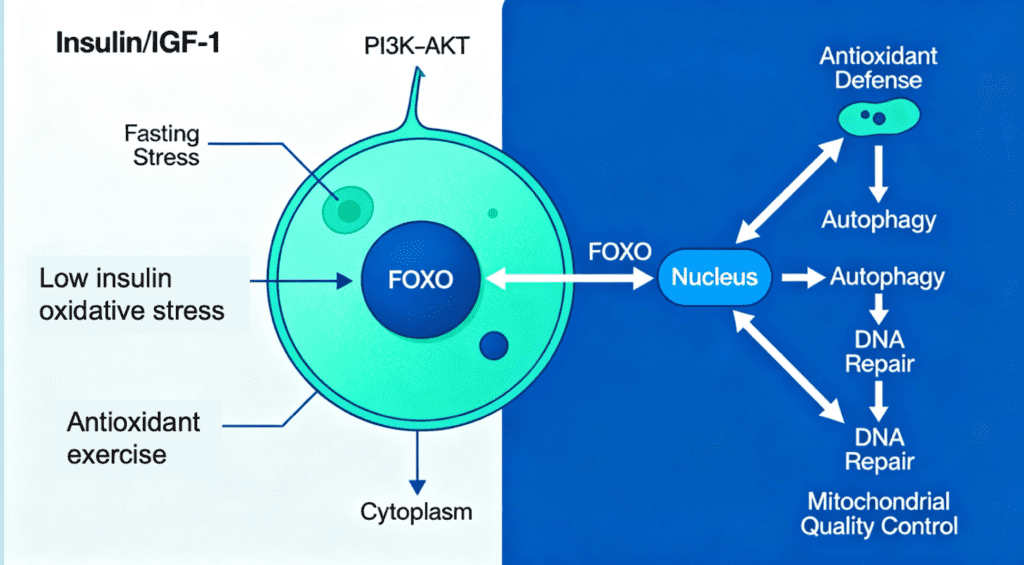
The insulin and insulin like growth factor 1 pathway is the main controller. When you eat, especially carbohydrate rich foods, insulin rises. This activates a signaling pathway inside cells that ultimately tags FOXO proteins and forces them out of the nucleus. When FOXO is pushed out of the nucleus, it cannot activate repair genes. The cell stays in growth mode.
During fasting, exercise, or cellular stress, insulin signaling drops. FOXO is no longer tagged or removed. It moves into the nucleus, binds directly to DNA, and turns on genes responsible for protection, cleanup, and survival. This is the cellular maintenance mode that becomes more important as we age.
What FOXO Does Inside the Cell
Antioxidant Defense
Normal metabolism produces reactive oxygen species, which damage DNA, proteins, and cell membranes over time. When FOXO is active, it increases the production of antioxidant enzymes such as superoxide dismutase, catalase, and glutathione related enzymes. These systems neutralize oxidative damage before it accumulates.
Much of FOXO’s longevity benefit appears to come from this improved control of oxidative stress.
Cellular Cleanup and Recycling
FOXO activates autophagy, the cell’s internal recycling system, and the proteasome, which breaks down damaged or misfolded proteins. Together, these systems prevent the buildup of toxic debris that contributes to aging and neurodegenerative disease. FOXO essentially encourages cells to clean house more often.
DNA Repair and Cancer Prevention
FOXO helps cells pause and repair DNA damage. If the damage is too severe, FOXO can initiate programmed cell death to remove dangerous cells. This is why FOXO acts as a tumor suppressor. Many cancers have disabled FOXO signaling, allowing damaged cells to survive and multiply.
Mitochondrial Health
FOXO supports mitochondrial quality control. It promotes the creation of new mitochondria while ensuring damaged ones are removed through a process called mitophagy. FOXO3 is especially important here, activating pathways that prevent dysfunctional mitochondria from flooding the cell with excess free radicals.
Healthy mitochondria are central to healthy aging, and FOXO is one of their key regulators.
Metabolic Regulation
FOXO1 helps regulate glucose and fat metabolism, especially in the liver. However, balance matters. In insulin resistance and diabetes, FOXO1 can become overactive in certain tissues, worsening metabolic problems. This reinforces a key theme in biology: FOXO is beneficial when properly regulated, not when chronically overactivated.
The FOXO and SIRT1 Partnership
FOXO does not work alone. It partners closely with SIRT1, a longevity associated enzyme that depends on NAD for activity. When energy availability is low, NAD levels rise. This activates SIRT1, which fine tunes FOXO activity to favor repair and stress resistance instead of cell death.
This FOXO SIRT1 partnership explains why caloric restriction and fasting consistently extend lifespan in animal models. They activate a coordinated repair program that improves mitochondrial efficiency, boosts cleanup pathways, and enhances stress tolerance.
This connection also explains interest in NAD precursors such as nicotinamide riboside and nicotinamide mononucleotide, which can support this pathway by increasing NAD availability.
FOXO and Stem Cell Health
FOXO is critical for maintaining adult stem cells. These cells are responsible for tissue repair throughout life. FOXO keeps stem cells protected, limits oxidative damage, and prevents premature depletion.
When FOXO signaling declines, stem cells accumulate damage and lose their regenerative capacity. This is one reason tissue repair slows with age. However, too much FOXO activity can also keep stem cells overly dormant. Again, balance is essential.
FOXO in Disease
FOXO generally protects against cancer by limiting uncontrolled growth. In neurodegenerative disease, moderate FOXO activity helps clear toxic proteins, while excessive activation can push neurons toward cell death. In cardiovascular disease, FOXO3 supports vascular health, but FOXO1 overactivity can impair heart function in certain conditions.
These examples highlight why FOXO is best viewed as a regulatory hub rather than a simple on off switch.
Lifestyle and Therapies That Influence FOXO
FOXO activity increases with fasting, exercise, NAD support, red and infrared light therapy, hyperbaric oxygen therapy, ozone based therapies, and certain medications like metformin and rapamycin. These interventions work through different entry points but converge on FOXO related repair pathways.
The most effective strategies use FOXO activation cyclically, allowing periods of repair followed by periods of growth and recovery.
The Principle of Balance
Longevity is not about maximizing FOXO activity. It is about optimizing it. The FOXO variants found in long lived individuals enhance protection without suppressing normal tissue function. This balance allows repair without sacrificing strength, immunity, or regeneration.
As longevity medicine evolves, the goal will be precise FOXO modulation based on tissue type, age, and physiologic state.
FOXO as a Central Hub of Longevity
FOXO sits at the crossroads of nutrition, stress, metabolism, and repair. Its deep evolutionary roots and strong association with human longevity make it one of the most important pathways in aging science.
When properly regulated, FOXO helps cells repair damage, maintain mitochondrial health, support stem cells, and resist disease. Longevity medicine is increasingly about learning how to work with this system rather than forcing it.
In many ways, healthy aging is about mastering balance in the same control systems that nature has refined over millions of years. FOXO is one of the most important of those systems.
Dr. P