














Mitochondria are often called the “power plants” of our cells, generating the energy needed to support everything from brain function and metabolism to recovery and healthy aging. As research into longevity and cellular health advances, scientists continue to uncover new factors that influence how well these critical structures function.
A recent study in the microscopic worm C. elegans explored the role of a molecule called S-adenosylmethionine (SAM) and revealed fascinating connections between mitochondrial health, membrane integrity, stress resilience, and lifespan.
While this research was conducted in worms, the mechanisms involved have important implications for human health and support many of the mitochondrial-focused therapies used in functional and longevity medicine today.
What Is SAM-e?
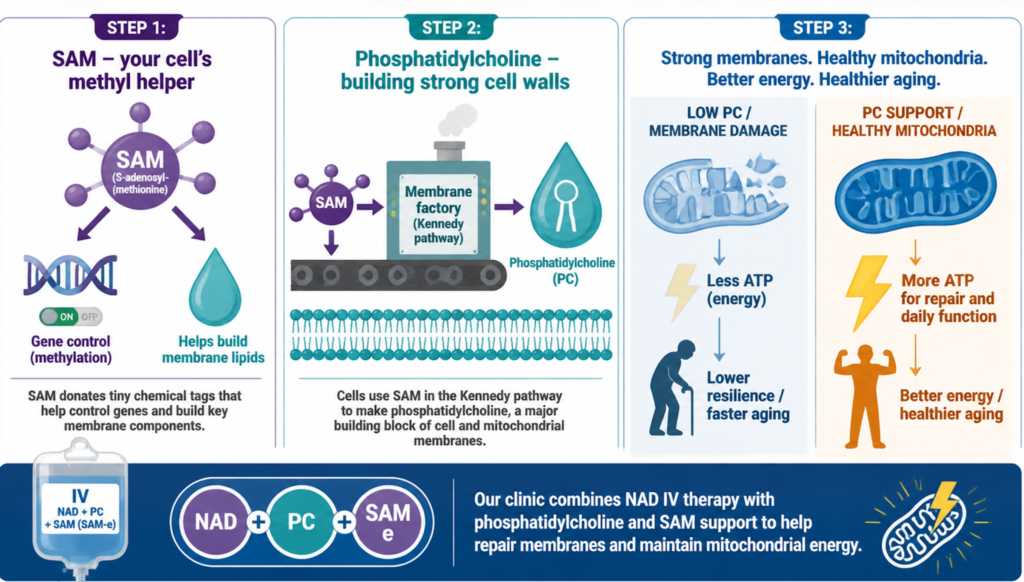
S-adenosylmethionine, commonly known as SAM-e, is produced naturally within the body and serves as the primary methyl donor for numerous biological processes.
Methylation helps regulate:
- Gene expression
- DNA and histone modification
- Neurotransmitter production
- Detoxification pathways
- Cell membrane synthesis
SAM-e is produced by an enzyme called SAMS-1 and plays a critical role in maintaining both cellular function and mitochondrial health.
In the C. elegans study, researchers found that reducing SAM levels caused mitochondria to become fragmented and dysfunctional. The worms exhibited increased signs of cellular stress, and their mitochondrial stress response—known as the mitochondrial unfolded protein response (UPRmt)—became activated.
Remarkably, when SAM levels were restored through dietary supplementation, much of the mitochondrial structure and function recovered, highlighting the molecule’s importance in maintaining healthy mitochondrial architecture.
The Connection Between SAM-e and Phosphatidylcholine
One of the most important ways SAM influences mitochondrial health is through its role in producing phosphatidylcholine (PC), one of the body’s most abundant membrane phospholipids.
In the study, researchers identified a pathway in which SAM is used to convert phosphoethanolamine into phosphocholine through a series of methylation reactions. Phosphocholine is then converted into phosphatidylcholine through what is known as the Kennedy pathway.
What Is the Kennedy Pathway?
The Kennedy pathway is the body’s primary system for building two essential membrane phospholipids:
- Phosphatidylcholine (PC)
- Phosphatidylethanolamine (PE)
These molecules form the structural foundation of cell membranes throughout the body, including mitochondrial membranes.
In this pathway, choline and ethanolamine are activated and attached to lipid backbones to create the phospholipids necessary for healthy membrane function. Because mitochondria rely heavily on membrane integrity to produce energy efficiently, the Kennedy pathway plays a critical role in cellular resilience and metabolic health.
Why Phosphatidylcholine Matters
Phosphatidylcholine is far more than a structural component.
It helps determine:
- Membrane fluidity
- Membrane stability
- Mitochondrial fusion and fission dynamics
- Cellular adaptability to stress
- Efficient energy production
When researchers disrupted phosphatidylcholine synthesis in the worms, the animals developed mitochondrial fragmentation similar to what occurred when SAM levels were reduced.
Interestingly, the effects on lifespan were context-dependent.
Reducing phosphatidylcholine synthesis extended lifespan in otherwise healthy worms but shortened lifespan in worms that already had mitochondrial dysfunction. This suggests that mild metabolic stress may sometimes stimulate beneficial adaptation, while the same stressor can become harmful when mitochondrial reserves are already compromised.
Beyond Membranes: SAM’s Role in Gene Regulation
The study also revealed that mitochondrial structure and mitochondrial stress responses do not always change together.
This finding suggests that SAM’s influence extends beyond membrane composition alone.
Because SAM serves as the body’s primary methyl donor, it helps regulate the activity of genes involved in:
- Stress adaptation
- Cellular repair
- Inflammation control
- Metabolic function
- Longevity pathways
In many ways, healthy mitochondria require both good “hardware” and good “software.”
The hardware consists of healthy cellular and mitochondrial membranes.
The software consists of properly regulated gene expression and cellular signaling.
SAM sits at the intersection of both systems.
Clinical Implications for Mitochondrial Health
These findings reinforce the importance of maintaining adequate phosphatidylcholine levels within cellular and mitochondrial membranes.
This concept aligns closely with a therapeutic strategy that I frequently utilize in clinical practice: phosphatidylcholine replacement therapy, particularly through intravenous administration.
IV phosphatidylcholine provides the body with direct access to this essential phospholipid at concentrations difficult to achieve through diet alone. By supplying the building blocks needed for membrane repair and maintenance, phosphatidylcholine may help support:
- Cellular membrane integrity
- Mitochondrial resilience
- Healthy detoxification processes
- Liver function
- Vascular health
- Energy production
Although the worm study did not specifically evaluate IV phosphatidylcholine therapy, the findings support the underlying biological rationale that healthier membranes support healthier mitochondria.
Why We Use SAM-e After NAD IV Therapy
At our clinic, we also incorporate SAM-e following NAD IV infusions.
NAD plays a central role in cellular energy production and repair, but these processes can increase demands on methylation pathways and membrane remodeling.
Providing SAM-e after NAD therapy helps support:
- Methylation capacity
- Gene regulation
- Phosphatidylcholine production
- Cellular repair processes
- Mitochondrial recovery
By addressing both membrane health and methylation support, this approach provides a more comprehensive strategy for optimizing mitochondrial function and cellular resilience.
The Takeaway
Emerging research continues to highlight the intimate relationship between mitochondrial health, membrane integrity, and healthy aging.
The SAM-e and phosphatidylcholine axis appears to play a central role in maintaining cellular energy production, stress resilience, and metabolic function. While further human studies are needed, these findings support a growing body of evidence suggesting that therapies aimed at supporting membrane health and methylation may be valuable tools for promoting long-term wellness.
Through targeted nutrition, lifestyle interventions, phosphatidylcholine therapy, and strategic SAM-e support, we can help create an environment where mitochondria function more efficiently—supporting energy, resilience, and healthier aging for years to come.
— Dr. Purita