












How PUR-FORM is exploring tibial photobiomodulation with EBO2 and plasmapheresis to prepare the biological environment for regenerative medicine
After more than two decades working in regenerative medicine, I have become increasingly convinced that we sometimes focus too much on what we put into the syringe and not enough on the patient receiving it.
We have made remarkable advances in bone marrow concentrates, mesenchymal stromal cells (MSCs), MUSE cells, extracellular vesicles, and other regenerative technologies. Yet even an excellent cell preparation enters a body with its own inflammatory environment, vascular supply, extracellular matrix, mitochondrial function, and ability, or inability, to respond to injury.
I frequently compare regenerative medicine to agriculture. We can plant the finest seeds available, but the condition of the soil will influence what happens next. The same principle may apply to regenerative treatment.
At PUR-FORM, we intend to explore a broader approach that combines methods for modifying the circulating environment with a noninvasive way to stimulate the patient’s own repair-associated signaling. One component is an approach I call Photobarics®, using light applied over the tibias with the Hemealumen® system.
The question is simple but important: can carefully delivered light influence circulating stem and progenitor-cell populations and, ultimately, help us prepare the biological environment for regenerative therapy?
The 2022 Human Pilot Study: A Surprising Observation
In 2022, Oron and colleagues reported a pilot study involving 15 healthy adults. Researchers applied an 808-nanometer near-infrared laser over both tibias and analyzed blood samples over the following days.
They reported that CD34-positive cells rose from approximately 7.8% to 29.5% of the analyzed circulating mononuclear-cell population, representing a relative increase of about 3.8-fold. The reported response peaked approximately two to four days after exposure.
That finding requires important context.
CD34 is expressed by certain hematopoietic stem and progenitor populations, among other cells. It does not identify MSCs or MUSE cells. Importantly, the 3.8-fold finding represented a change in percentage, not a demonstrated 3.8-fold increase in absolute stem-cell numbers.
The trial was also small, lacked a sham-control group, and did not trace the cells to their tissue of origin or demonstrate a clinical healing benefit.
Still, the observation is compelling. The investigators did not infuse cells or administer a traditional mobilizing drug. They exposed two accessible long bones to light and subsequently measured a change in the circulating cell profile.
Why the Tibia?
In adults, much of the tibial shaft contains fatty yellow marrow rather than the active red marrow that is more abundant in the pelvis, vertebrae, and proximal regions of certain long bones.
Because of this, it is not immediately obvious that illuminating the tibia would directly release large numbers of marrow progenitors.
Several explanations remain possible. These include local vascular or stromal signaling, responses in residual marrow tissue, or indirect signals acting on distant marrow compartments.
The 2022 trial did not establish which, if any, of these mechanisms accounts for the observed changes. I find that uncertainty interesting because regeneration involves communication among tissues, not merely the activity of one cell type.
Introducing Photobarics® With the Hemealumen® System
At PUR-FORM, we use Hemealumen® PhotoBioModulation pads positioned over the anterior tibial regions.
The approach I call Photobarics® explores whether selected light exposures may influence mitochondrial, vascular, or marrow-associated signaling and, in turn, circulating repair-associated cells.
The name acknowledges a conceptual parallel with hyperbaric oxygen therapy, which has also been studied for progenitor-cell mobilization. However, the modalities use different physical mechanisms and should not be considered equivalent.
This concept builds on the work of Oron and colleagues, who used a specific 808-nm laser in their study.
How Might Photobarics® Influence Cellular Biology?
The mechanisms remain under investigation, but several biological pathways offer plausible areas of interest.
Mitochondrial and Redox Signaling
Mitochondria do far more than produce ATP. They participate in cell signaling, calcium regulation, redox balance, and stress responses.
Experimental PhotoBioModulation research suggests that certain exposures to red and near-infrared light can influence mitochondrial-associated pathways. Cytochrome c oxidase is a proposed light-sensitive target, although the mechanisms remain dose-dependent and context-dependent. [4]
Nitric Oxide and the Vascular Environment
Nitric oxide regulates vascular tone and participates in endothelial and cellular signaling.
Some PhotoBioModulation exposures can influence nitric oxide-associated responses. Because progenitor-cell niches are closely associated with blood vessels, these effects offer a plausible, but unproven, connection between light exposure and changes in circulating cell populations.
Marrow Niches and Cell Trafficking
Bone marrow is not simply a reservoir of cells.
Stromal cells, endothelial cells, extracellular matrix molecules, chemokines, and adhesion systems all contribute to progenitor retention and release.
It is possible that local light exposure changes parts of this signaling network, or that it induces indirect systemic responses. However, the human tibial pilot did not demonstrate a specific mechanism or prove that CD34-positive cells were mobilized from the illuminated bones.
An Interesting Parallel With Hyperbaric Oxygen
There is an interesting precedent for a physical intervention affecting circulating progenitor-cell measurements.
In 2006, Thom and colleagues reported a doubling of circulating CD34-positive cells after one two-hour hyperbaric oxygen treatment and an approximately eightfold increase over 20 treatments. Animal experiments implicated nitric oxide-dependent signaling. [3]
This example demonstrates that a physical intervention can alter circulating progenitor-cell measures. It does not establish that light and hyperbaric oxygen share an identical mechanism, nor does it prove that combining the two increases regenerative outcomes.
Preparing the Biological Soil: EBO2, Plasmapheresis, and Photobarics®
At PUR-FORM, our proposed clinical strategy brings together three distinct approaches: EBO2, therapeutic plasmapheresis, and Photobarics®.
The purpose is not simply to stack technologies. It is to investigate whether addressing different aspects of the host environment can complement the regenerative cells or biologics we administer.
EBO2: Exploring Redox and Inflammatory Signaling
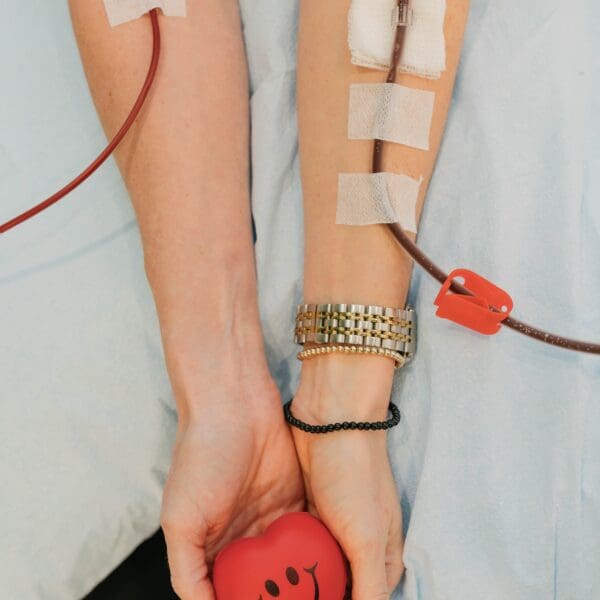
EBO2 involves extracorporeal blood processing with oxygen and ozone exposure and, depending on the system, additional components.
Ozone reactions generate secondary molecules, including hydrogen peroxide and lipid oxidation products, that can influence stress-response pathways in experimental settings. Nrf2-related signaling is one area of interest.
Plasmapheresis: Modifying Circulating Plasma Factors
Therapeutic plasma exchange removes a portion of circulating plasma and replaces it with an appropriate fluid.
The process can reduce selected antibodies, plasma proteins, and other circulating substances.
Experimental plasma-dilution and aging research has raised questions about how circulating factors influence tissue function, but this research does not prove that plasmapheresis reverses human aging or improves stem-cell therapy outcomes.
Photobarics®: Investigating Endogenous Cell Signaling
Photobarics® would add a different dimension to this strategy: a noninvasive light-based stimulus delivered over the tibias.
The immediate research questions are whether it changes absolute circulating CD34-positive cell counts, which subpopulations respond, and whether the changes are reproducible with Hemealumen®.
The hypothesis is that EBO2 may modulate redox and inflammatory signals, plasmapheresis may alter plasma composition, and Photobarics® may influence endogenous vascular or progenitor-cell signaling.
These are complementary research aims. They are not proof of additive clinical benefit.
Another question worth exploring is whether irradiating the pelvis could further increase stem-cell output. We typically obtain stem cells from bone marrow aspiration because the marrow can provide a high cell yield. Whether targeted light exposure over this region could influence mobilization remains a question for future study.
Preparing the Patient Before Administering Regenerative Cells
When we administer MSCs, MUSE cells, or other regenerative products, the environment they encounter shapes their effects.
Inflammation, tissue oxygenation, microcirculation, immune signaling, and extracellular matrix integrity can all affect tissue responses.
This raises a question that I believe deserves greater emphasis: should preparing the patient become as important as preparing the cellular product?
Our planned combination strategy reflects that philosophy.
It is not a substitute for high-quality cell products, nor is it evidence that it guarantees better outcomes. It is a research direction centered on understanding how the recipient’s biology participates in regeneration.
The Measurements I Would Like to See
If we are going to explore Photobarics® seriously, the measurements need to be rigorous.
I would begin with standardized serial blood sampling before and after Hemealumen® tibial treatment. Key measurements should include absolute CD34-positive counts per microliter, carefully gated cell subtypes, and relevant vascular or inflammatory markers.
Time points should reflect the two-to-four-day peak reported in the original pilot, without assuming that Hemealumen® will have the same kinetics.
Subsequent controlled studies could compare Photobarics® alone with selected combinations involving EBO2 or plasmapheresis, while monitoring safety and potential interactions.
Ultimately, however, we need outcomes that matter to patients: function, pain, quality of life, and, where appropriate, objective tissue recovery.
Changes in a laboratory marker alone are not enough.
Looking Beyond the Syringe
Regenerative medicine has spent years learning how to obtain and administer better cells. I believe the next evolution may also involve learning how to support the biological environment in which those cells must function.
Photobarics® is one promising question to investigate, not an answer that has already been proven.
At PUR-FORM, the planned integration of Photobarics® with EBO2 and plasmapheresis reflects our interest in the host as an active participant in repair.
I have often said that cells, not doctors, ultimately do the healing. Our responsibility is to understand their biology, measure our interventions rigorously, and discover which approaches truly help patients.
That is what makes this direction interesting to me. The goal is not simply to find a better syringe, a better cell product, or another technology to add to the treatment room. It is to better understand the entire biological setting in which regeneration has to take place.
The goal is not simply to plant better seeds. It is to understand and prepare the soil in which regeneration must occur.
Dr. P